Intermediate 301 Guide To Learning AI Automations
Most People Are Wrong About AI Agents
Most people misunderstand AI agents. The biggest myth is that you need to be a senior engineer or machine learning expert to build one. That assumption keeps capable people on the sidelines while others quietly automate large portions of their work.
I believed that myth myself.
Why AI Agents Feel More Complex Than They Are
When I first attempted to build an AI agent, I went down the same path many people do. I opened GitHub repositories, skimmed dense documentation, and ran into deep learning jargon that made the entire process feel inaccessible. It felt like something reserved for PhDs and senior engineers.
The breakthrough came from frustration, not expertise. I had a repetitive task at work that no one had time to solve properly. Instead of chasing complex architectures, I tried a simple tool-based agent using plain English prompts and existing APIs. It worked immediately. Not because I became more technical, but because the tools had matured.
What AI Agents Actually Are
AI agents are not conscious systems or autonomous robots. At their core, they are decision loops. They observe inputs, decide on an action, and execute using available tools. Large language models simply act as the reasoning engine inside that loop.
Modern frameworks like crewAI and LangGraph make this explicit. Even low-code and no-code platforms now allow users to define tasks, assign tools, and set outcomes without writing thousands of lines of code. The complexity has been abstracted away.
Practical Uses for AI Agents Today
The most effective applications are not flashy. They are operational.
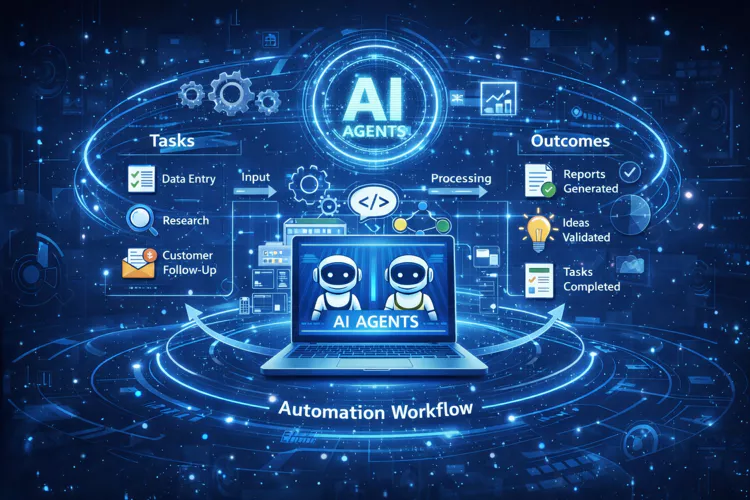
Small businesses are using no-code AI agents to automate onboarding, customer follow-ups, and internal documentation. Solo creators are running research workflows overnight, summarizing content, validating ideas, and preparing drafts while they sleep.
These are not experimental projects. They are production workflows built by non-engineers who understand the process they want automated.
The Real Barrier to Building AI Agents
The barrier is no longer technical skill. It is conceptual clarity.
People who succeed with AI agents think in terms of tasks, tools, and outcomes. They break work into steps, identify what decisions are required, and map those decisions to tools an agent can use. Once that mindset clicks, building agents becomes straightforward.
Those who wait to become experts miss the opportunity. The advantage now belongs to operators who understand their workflows better than anyone else.
AI agents are not about replacing humans. They are about removing friction from repetitive work so focus can shift to higher leverage decisions.